On a cold November afternoon in 1872, Scotland and England walked onto a cricket ground in Glasgow to play what would become the first officially recognised international football match. There were no television cameras, no sponsors, no transfer fees. Just twenty-two men, a ball, and the beginning of everything.
Over the next twenty-seven years, four nations - Scotland, England, Wales, and Ireland - would meet 125 times, creating the blueprint for international football as we know it. The British Home Championship, formalised in 1884, became the world's first international tournament. The scores were extraordinary, the travel was tough, and Scotland were utterly dominant.
The home team won over half of all matches. Away travel across the British Isles was a genuine ordeal in the 19th century.
 Scotland
68 games
 England
67 games
 Wales
Wales63 games
 Ireland
52 games
The Pecking Order
The hierarchy of 19th-century football was stark. Scotland were the supreme force, winning 49 of their 68 games and never once losing to Wales or Ireland across a combined 40 matches. England were the clear second power. Wales and Ireland competed fiercely against each other for third place, but rarely troubled the top two.
The radar chart reveals just how far ahead Scotland were. Their win percentage, goal-scoring rate, and clean sheet record put them in a league of their own. A dominance that would only begin to erode after the turn of the century.
The Rivalry Web
Six unique matchups connected these four nations. Scotland vs England was the most frequent encounter, 28 games in 27 years, and the most competitive, with Scotland holding a 13-9 advantage. The thickest connections tell the story of the era: the annual Home Championship fixtures that became the centrepiece of each nation's calendar.
Note the stark contrast: Wales never beat Scotland in 24 attempts. Ireland never beat Scotland (16 games) or England (18 games). The gulf in quality was enormous. But that didn't stop them turning up, year after year.
The Growth of the Game
From a single game in 1872 to six fixtures per year by the mid-1880s, the chart below tracks how quickly international football took hold. The golden bars show the number of games each year, while the blue line tracks the average goals per match, a measure of attacking intent that fluctuated wildly in these early years.
The expansion was directly tied to new teams entering the fold. Wales joined in 1876, Ireland in 1882. The British Home Championship, formalised in 1884, guaranteed six fixtures every season, giving the annual calendar a structure that would persist for over a century.
The Scoreline Matrix
Modern football fans used to tight 1-0 victories would barely recognise the 19th century game. Goals flowed freely and the average match produced 5.3 goals. The heatmap below maps every scoreline recorded: the brightest cells reveal the most common results. Notice how lopsided the grid is. High-scoring home wins were the norm, not the exception.
Where They Played
Twenty-seven cities across the British Isles hosted these pioneering matches. The geography tells its own story: Glasgow, Belfast, and Wrecsam served as the home fortresses of Scotland, Ireland, and Wales respectively, while England rotated through a constellation of industrial cities. Each bubble represents a host city - larger bubbles mean more games.
Glasgow alone hosted 28 matches, more than any other city. Belfast (26) and Wrecsam (25) completed the trio of regular venues. London, despite being the capital, hosted just 12 games - reflecting the era's preference for northern and industrial centres.
A Golden Age of Goals
With an average of 5.3 goals per game, the 19th century was a wildly different era. The Nightingale rose chart below shows the distribution: most games produced 3-6 goals, but double-digit scorelines were not uncommon. The most goals in a single match? A staggering 15, when England thrashed Ireland 13-2 in February 1899.
Against the Odds
Even in an era of clear hierarchies, upsets happened. The scatter plot below maps every game by its rating expectation vs actual result. Points near the diagonal represent expected outcomes, and the glowing markers highlight the biggest surprises where the underdog defied the numbers.
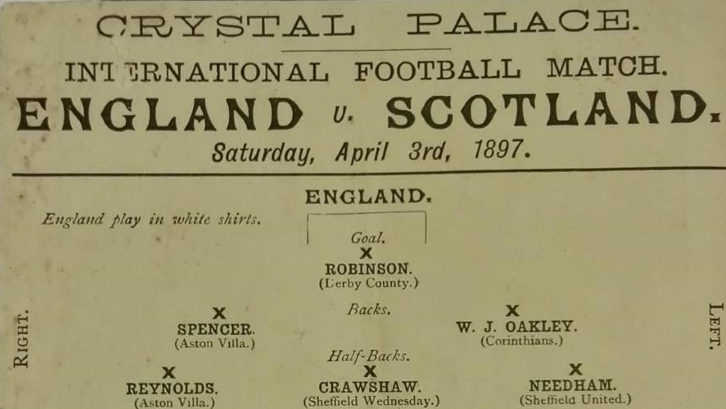
The greatest upset of the era came on 3 April 1897, when Scotland travelled to London and beat England 2-1 despite being given just a 34.6% chance. Wales' shock 1-0 victory over England in 1881, their first-ever win against the English, also stands out as a landmark moment.
Defining Moments
From the very first international to Ireland's 13-goal baptism of fire, these are the games that shaped the birth of international football.
Scotland 0-0 England
30 November 1872 · Hamilton Crescent, Glasgow
The game that started it all. Before a crowd of around 4,000 at a cricket ground in Partick, Scotland and England played out a goalless draw. The Scots played an innovative passing game; the English relied on individual dribbling. Football would never be the same.
Scotland 7-2 England
2 March 1878 · Hampden Park, Glasgow
Scotland demolished England 7-2 at the first Hampden Park, their biggest-ever victory over the Auld Enemy. Leading 4-0 at half-time, the Scots' passing style was years ahead of its time. This scoreline would stand as a record between the nations for decades.
England 0-1 Wales
26 February 1881 · Kennington Oval, Blackburn
Wales stunned England 1-0, one of the era's greatest upsets. The Welsh had been given just a 36% chance by the ratings. It was their first victory over England and a watershed moment for Welsh football, proving the smaller nations could compete at the highest level.
Ireland 0-13 England
18 February 1882 · Ballynafeigh Park, Belfast
Ireland's first-ever international match was a harsh introduction. England won 13-0, a scoreline that remains the joint-heaviest defeat in international football history. Ireland were conceding five goals before half-time, yet they returned the following week and every year after. That resilience defined a nation.
Scotland 0-5 England
17 March 1888 · Hampden Park, Glasgow
England travelled to Glasgow's Hampden Park, the fortress where Scotland were virtually unbeatable, and produced one of the era's most stunning results: a 5-0 demolition. Given just a 35.8% chance by the ratings, England's victory shattered the myth of Scottish invincibility at home.
England 13-2 Ireland
18 February 1899 · Roker Park, Sunderland
England 13-2 Ireland. 15 goals, the highest-scoring match in this entire dataset. By half-time, England already led 5-2. The match captured the gulf between the established powers and the newcomers, yet it also produced more goals for Ireland in a single game than in many of their other matches combined.
The Legacy
These 125 games laid the foundation for everything that followed. The British Home Championship they created would run until 1984. The fixture formats they pioneered became the template for FIFA's world-governing structure. Scotland's passing game influenced tactical thinking for generations. And the very concept of one nation playing another, which seems so obvious now, had to be invented somewhere, by someone.
When the 20th century arrived, the game was ready to go global. These four nations had proven the concept. Now the rest of the world wanted in.
Complete Match Archive
All 125 verified international matches played before 1 January 1900, organised by decade.